Been hearing a lot about extensive reading and comprehensible input lately, and how this is supposed to be the best way to reach fluency in a language.
I think it makes sense that the best way to learn a language is to actually be using it to get your brain processing the meaning of what is being stated whether it be written or verbals communication.
The problem is the two languages I'm trying to learn are both pretty difficult to read. There is an extra mountain to climb with Chinese characters which making reading the language much easier said than done.
I guess the upshot is that if I was studying a language like Spanish, for example, where the characters being used were instantly recognisable, I'd be able to get to the point where extensive reading was a viable option a lot sooner than for a language like Japanese where I still feel after six years of study that reading a short article is a pretty big task.
Showing posts with label linguistics. Show all posts
Showing posts with label linguistics. Show all posts
Monday, 9 July 2012

Saturday, 20 August 2011
Update and new thoughts on grammar
Well, what with summer holidays and the like it's been a while since my last post, so I'm just writing this as a quick update as to what's going on.
I've got a lot of topics that I want to blog about language learning lined up, it's just that I've come to the conclusion that I'm spending too much time blogging about it and not enough time studying, so I've decided to concentrate on the study a bit for the time being.
I'm using the Oxford Chinese site that I mentioned before, and I'm really beginning to appreciate the benefit of grammar exercises. I think I had been lulled into thinking it was not necessary by some quarters of the language learning world, and this has been detrimental to my progress. Looking back at this blog, I am not sure I would support everything I wrote here or here anymore (although think balance is probably the best way forward, and certainly there is room for both techniques).
It is an atractive proposal not to have to bother with grammar, but I'm finding that studying the grammar really gives you a better understanding of the language and helps to give you a firm foundation from where to build your sentences, and this in turn helps to raise confidence.
Anyway, I'm going to try to make my way through all these exercises over the next month or two, and then perhaps scout around for some new material.
In the meantime, I'll try to find some time for a blog post or two. If you have any thoughts on the benefits of grammar study please let me know in the comments below, or of course if you have any comments on my blog or language learning in general, feel free to drop me a line...
Wednesday, 22 June 2011
Surprising Kanji
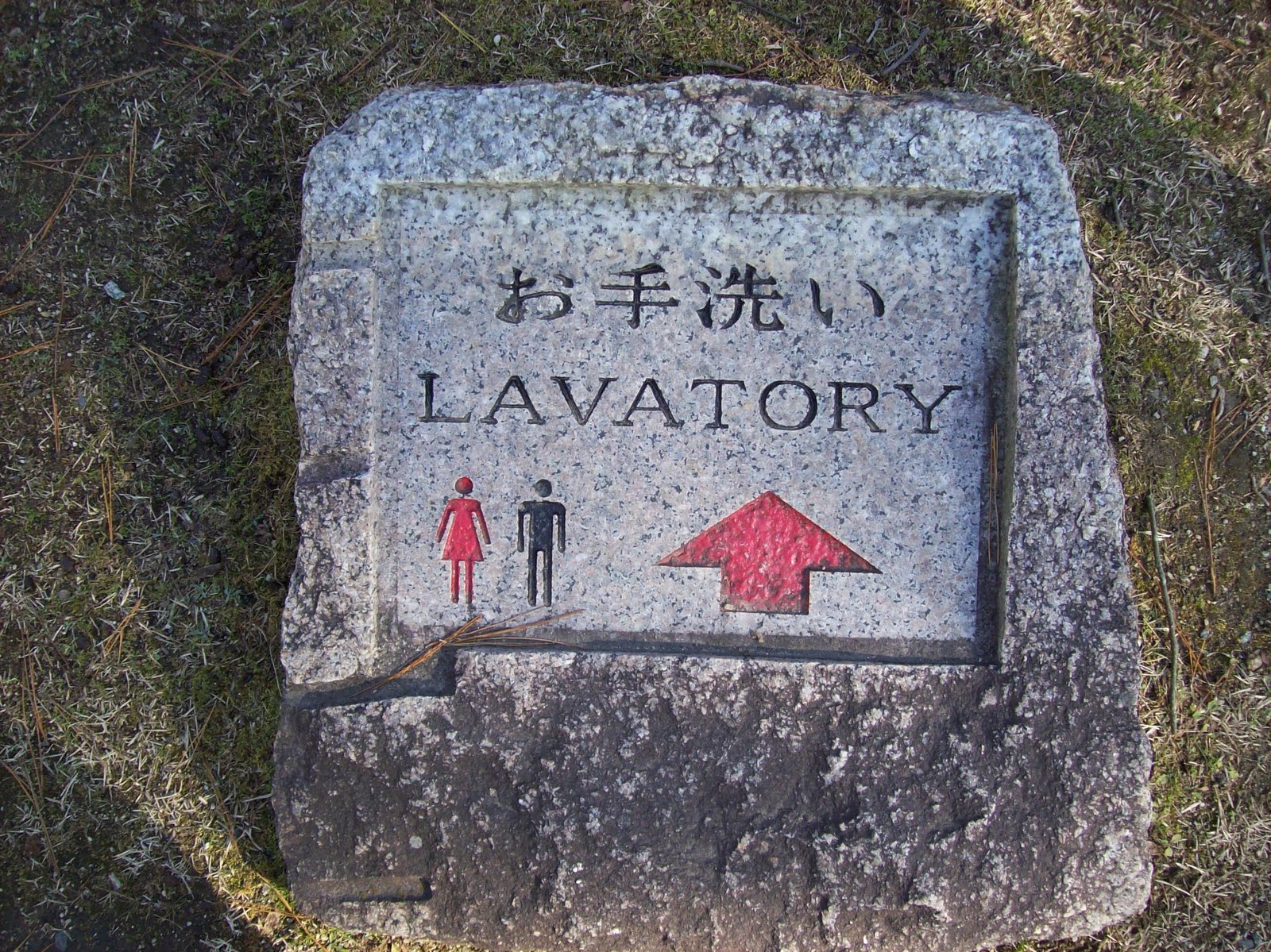 |
| (手=hand + 洗=wash) = toilet |
美味しい / おいしい / oishii / tastes good
A word so common on Japanese TV, you only have to flick through a couple of channels and you are bound to here it. Often translated as 'tasty' or 'delicious' leading to odd sounding conversations with Japanese people in English about food. おいしい is most commonly written using hiragana, but occasionally is displayed in Kanji. These two Kanji are 実 beauty, and 味 taste— makes sense if you think about it I guess.
Another example is 上手い / うまい / umai / skillful, good at
Now I learnt 上手 じょうず jyouzu a long time ago, and I knew the kanji for じょうず was up (上) and hand (手). Up-hand "good at something" seems to make sense. Later on I ran into the more casual うまい which also means good, or skillful, but it wasn't until recently that I found out that うまい was transcribed as 上手い using kanji, because it's not so common to see it written like this— I guess the reason being that it's easy to get it confused with じょうず 上手.
お洒落 / おしゃれ / Oshare / smart, flashy, fashionable, stylish.
Again, I often saw this in hiragana on TV, but only recently found out the Kanji: 洒: wash or sprinkle, 落: fall, drop, come down お洒落 sprinkle, come down = fashionable, stylish, I can make that connection.
面白い / おもしろい / omoshiroi / interesting; funny
I was pretty embarrassed when I couldn't read this kanji after having studied Japanese for about two years, seeing as it's one of the most common words in the language! But I guess I'd just never come across it in kanji form before. 面: face, features, surface 白: white. White surface = interesting. Hmm, I guess if you're being sarcastic perhaps.
This is what I really like about kanji. The way you can connect the meaning of characters to make various connotations. Great fun, beats the Roman alphabet hands down. — (下手 へた 下: down 手: hand, down hand = rubbish, not skillful)
Wednesday, 11 May 2011
Why children learn languages faster than adults: my two cents
When reading literature on language learning, and talking to language learners, again and again you hear the refrain "children learn languages a lot faster than adults."
I've read a lot of theories as to why this is, and I think the most convincing for me is that children have less fear of making mistakes than adults.
I often get daunted by Japanese. I hear something, a construction or idiom, and it daunts me to think I've been learning for five years, but haven't come across that phrase yet. I begin to wonder, how many of these unknown phrases are there out there? And how incredibly long will it take me to come across them all?
So I got to thinking about how a kid overcomes these problems: what makes them so immune from this? Why doesn't a child get daunted when it hears its parents, or the television, babbling away in unrecognisable jargon?
The conclusion I reached was that children clearly just don't care. They couldn't give a monkey's elbow about what the two adults in the corner of the room are babbling on about, because it's not important for them. It doesn't relate to their world. A child will not bother to try to understand a phrase or idiom they don't understand because it's not aimed at them, and it's not necessary for them to understand.
The people children speak to, their friends, parents, or teachers, don't speak to them using adult language, they don't use the sort of language that they would find going above their head.
I think this is what makes it easier for a child to learn a language, they are at the right age to speak the basics of a language and they don't need anything else. They are able to gradually build their vocabulary and knowledge of the language as their social needs require.
As an adult language learner I should be doing the same.
Of course this raises it's own difficulties in that I have to restrict myself to childish conversations in the beginning stages of my learning. As adults we often find ourselves in social situations that require a certain amount of maturity in conversation, and when you enter into a conversation as a beginner language learner this is pretty hard to do to say the least.
The temptation is, therefore, to try to learn language early on that you would like to use in an 'adult' conversation. This is something I've mentioned before as being one of my biggest failings as a language learner: the temptation to get ahead of myself in my impatience to reach fluency.
This results in me often finding myself in awkward positions where I am trying to say something that I don't have the linguistic skill to do, which results in a silence and the social awkwardness that this entails. Confidence is then affected, and loss of confidence is the worst thing that can happen for a language learner.
So I guess, my point is, speak like a child when starting out in a language, and don't be ashamed of it. The more confidently you use childish language the quicker you will begin to make progress and begin to sound like an adult. If this means you have to restrict the number of occasions you are able to speak the language in the beginning stages then so be it—although I don't think there is anything wrong in making basic sentences in an adult setting, just be sure to do it with the kind of swagger of someone who is comfortable with the fact that they are a beginner and not someone who is trying to feign knowledge of a language they don't have: be like the impudent child who isn't afraid to speak up when the adults are having a discussion.
Sunday, 1 May 2011
Trying to remove ambiguity from the meaning of words
Following up on yesterday's post.
I've just noticed another example of this dislocation between word and meaning. I'm watching politicians on TV and they keep using the word 地域(ちいき/Chiiki): area, or region.
I can't disassociate this word with the English word 'cheeky'. They sound very similar—so similar that everytime I hear 地域 I immediately think about the word cheeky, and secretly snigger to myself about the similarity. Of course I remember that 地域 means region (using the cheeky similarity was a good mnemonic to remember the word in the first place), but it doesn't produce the same initial reaction in me that it would to a native speaker of Japanese, and therefore inhibits my understanding of the language. (Japanese speaker thinks 'region'; I think 'sounds like cheeky, snicker.'
Trying to focus on the real meaning of the word when I hear it would help to overcome this, but I think the best way to make the connection permenant is to have real, meaningful experience using the word.
For example, recently there have been a lot of problems in Japan due to the earthquake and tsunami, and I have learnt a lot of new words. There is no ambiguity for me in these words—放射線 means radiation, there's no doubt in my mind. It's a word that creates the same reaction in me as the English version: concern. This is because I've had real, meaningful experience with this word and the consequences it can cause.
I think this is a good example of the difficulty in learning new words. New words start off as a noise with no meaning; you can then learn the meaning and make the association, but does it really become meaningful to you until you actually have a reason to use, or think about the word, that actually affects you directly?
Subscribe to:
Posts (Atom)