Showing posts with label tv. Show all posts

Sunday, 11 October 2020

Trying Japanese dramas with Amazon Prime

I have subscribed to Amazon Prime and taken a monthly subscription to NHK On Demand. I used to have a television, and used to really like watching the documentaries on NHK. NHK Special makes some really good programming. Even if I could only understand 50%, I could still follow the gist of the programme, and the production quality made it enjoyable. Of course, it also helped improve my Japanese.

I don't have a TV anymore, so I decided to subscribe to the NHK on demand through Amazon. It's not too expensive at maybe 2-3000 yen per month.

The other day, I thought I'd branch out and try some Japanese dramas. I have dipped my toes in the Japanese drama world previously, always to be disappointed.

I was browsing the many dramas on prime and this one caught my eye - not sure why - but I thought let's give this a go.
 

The opening scene of the 1st episode of the 1st series, has the lady who I presume is the heroine of the series, marching along a coutry path in-between rice fields wearing high-heels and a short skirt. She seems to be in a hurry. We then cut to a horse race meeting. She has bought a ticket and is seems very excitable as she waits in the stand for the race to start. The other people in the stand also seem very focused on the upcoming race and excitable - I could only conclude that this race was of great importance - despite the small crowd. 

The race starts and the lady screams and shouts like her life depends on the outcome of the race; however, on the final straight her horse throws it's rider to the ground. Cue tearing up of bet ticket and much hysteria. Oh, I forgot to mention, during this the scene cuts to a youngish businessman and older lady sat in one of the corporate boxes. There seems to be something serious going on between them. The lady perhaps is blackmailing him. 

Anyway, cut back to the race and the heroine storms from the stand after her colleague - who happened to be next to her - and arrives at the scene of the rider of the horse being stretchered to an arriving ambulance. Out of the ambulance jumps a young doctor who seems slightly out-of-place riding in the ambulance itself - as if in his country hospital this was the first time the ambulance had ever been called out and he was determined to be there for the moment. He runs to the car park and begins immediately treating the injured jockey. At this point, of course, the heroine recognizes him, he her, and they have an hysterical conversation in the car park - he has now forgotten about the jockey. Until the jockey starts coughing up blood. 

Enough! I had to stop. I don't know what to call this type of drama. It's sort of hysterical-fantasy-realism. Perhaps the idea is to recreate manga with real actors, but it is not really my cup of tea, so I will be sticking with the documentaries for now.

Thursday, 30 May 2013

Vocab drive

I'm on a drive to learn as much vocabulary as possible.

The longer I study Japanese, the more the enormity of the task becomes apparent to me, and therefore the more time I end up committing to it.

On recent consideration of how slow my progress was becoming I decided to start watching as much TV as possible. My self-satisfaction at being able to work out what the plotline of a particular drama was was soon tempered by the realization that over 50% of the vocabulary is still unknown to me. Hence the vocab drive.

Using the Anki flashcards and the tangorin dictionary website I've set up a system where every new word I come across is saved into tangorin, and then example sentences uploaded to anki at the end of the month. I'm then able to review the vocab over the next couple of months on my phone.

I've actually been using this system for over a year now, and I'm starting to see some good results. It's a good feeling when a word you have recently been learning crops up on TV and your understanding of that word opens up a whole new area of meaning to the conversation that you're listening to. It's like an extra light being turned on in a badly lit room.

Sunday, 22 April 2012

New iPhone

One thing that has a good effect on my language learning of late has been my new iPhone. It's my first smartphone and I've had it for a couple of months now. I downloaded the Anki app which has really enabled my flashcard usage to go up dramatically. It's great being able to check your flashcards for one minute or so while you are waiting for the train, or waiting at the pedestrian crossing or whatever. I'd say my use of flashcards has gone up by at least 100% if not a lot more.

家政婦の三田 on pps.tv

Another app that is useful is pps.tv. It's an app for a Chinese website where you can access all sorts of TV shows, movies etc. There is a Japanese drama category and I've been trying to watch a drama series from start to finish. There are subtitles in Chinese and Japanese! On the whole, I keep my eyes on the Japanese subs, and manage to follow what's going on quite well. From time to time though, I take a look at the Chinese subs too and get a bit of study in that way too.

The drama I've been watching is, like a lot of Japanese dramas, wacky as hell. It's called 家政婦の三田 (Kaseifu no Mita; Mita the housekeeper) and it's about a housekeeper who is working in the home of a bereaved family who have lost their mother/wife. The wacky thing is the housekeeper behaves like a housekeeping robot behaving and working perfectly, beyond belief, so much so that she actually creeps people out. It's wacky, but interesting to watch, and I'm looking forward to finding out why the woman/robot is as wacky as she is.

I held out from purchasing an iPhone for quite a while, but I've got to say it's a good purchase.

Wednesday, 22 June 2011

Surprising Kanji

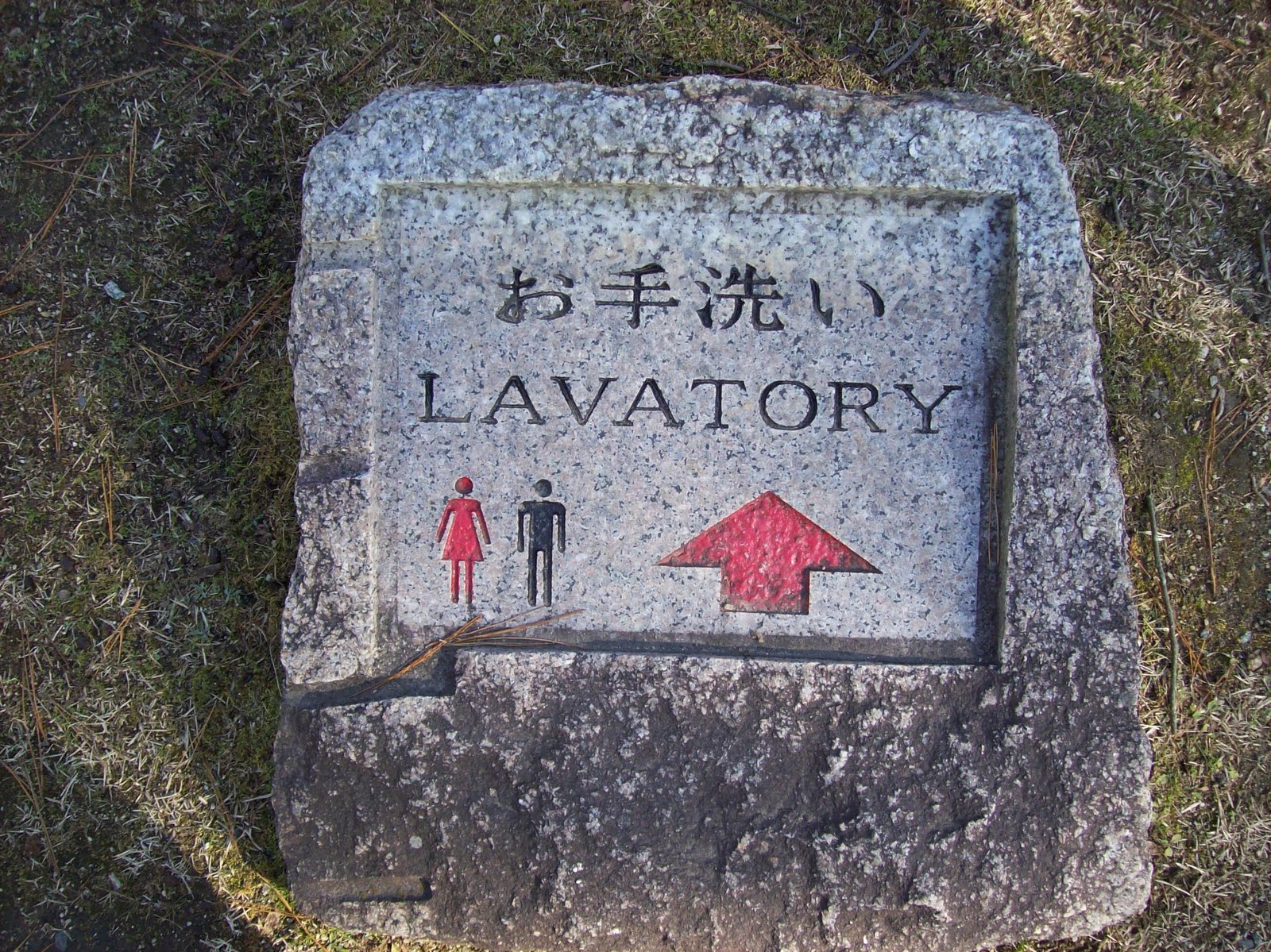
(手=hand + 洗=wash) = toilet
Every now and again I come across a word that is usually written in hiragana or katakana displayed in Kanji. Sometimes the kanji used are quite surprising. Here are some examples:

美味しい /  おいしい / oishii / tastes good

A word so common on Japanese TV, you only have to flick through a couple of channels and you are bound to here it. Often translated as 'tasty' or 'delicious' leading to odd sounding conversations with Japanese people in English about food. おいしい is most commonly written using hiragana, but occasionally is displayed in Kanji. These two Kanji are 実 beauty, and 味 taste— makes sense if you think about it I guess.

Another example is 上手い / うまい / umai / skillful, good at

Now I learnt 上手 じょうず jyouzu a long time ago, and I knew the kanji for じょうず was up (上) and hand (手). Up-hand "good at something" seems to make sense. Later on I ran into the more casual うまい  which also means good, or skillful, but it wasn't until recently that I found out that うまい was transcribed as 上手い using kanji, because it's not so common to see it written like this— I guess the reason being that it's easy to get it confused with じょうず 上手.

お洒落  /  おしゃれ  /  Oshare  /  smart, flashy, fashionable, stylish.

Again, I often saw this in hiragana on TV, but only recently found out the Kanji: 洒: wash or sprinkle, 落: fall, drop, come down お洒落 sprinkle, come down = fashionable, stylish, I can make that connection.

面白い /  おもしろい  /   omoshiroi  /  interesting; funny

I was pretty embarrassed when I couldn't read this kanji after having studied Japanese for about two years, seeing as it's one of the most common words in the language! But I guess I'd just never come across it in kanji form before. 面: face, features, surface 白: white. White surface = interesting. Hmm, I guess if you're being sarcastic perhaps.

This is what I really like about kanji. The way you can connect the meaning of characters to make various connotations. Great fun, beats the Roman alphabet hands down. — (下手 へた 下: down 手: hand, down hand = rubbish, not skillful)

Sunday, 1 May 2011

Trying to remove ambiguity from the meaning of words

Following up on yesterday's post.

I've just noticed another example of this dislocation between word and meaning. I'm watching politicians on TV and they keep using the  word 地域(ちいき/Chiiki): area, or region.

I can't disassociate this word with the English word 'cheeky'. They sound very similar—so similar that everytime I hear 地域 I immediately think about the word cheeky, and secretly snigger to myself about the similarity. Of course I remember that 地域 means region (using the cheeky similarity was a good mnemonic to remember the word in the first place), but it doesn't produce the same initial reaction in me that it would to a native speaker of Japanese, and therefore inhibits my understanding of the language. (Japanese speaker thinks 'region'; I think 'sounds like cheeky, snicker.'

Trying to focus on the real meaning of the word when I hear it would help to overcome this, but I think the best way to make the connection permenant is to have real, meaningful experience using the word.

For example, recently there have been a lot of problems in Japan due to the earthquake and tsunami, and I have learnt a lot of new words. There is no ambiguity for me in these words—放射線 means radiation, there's no doubt in my mind. It's a word that creates the same reaction in me as the English version: concern. This is because I've had real, meaningful experience with this word and the consequences it can cause.

I think this is a good example of the difficulty in learning new words. New words start off as a noise with no meaning; you can then learn the meaning and make the association, but does it really become meaningful to you until you actually have a reason to use, or think about the word, that actually affects you directly?

Thursday, 5 August 2010

New name

So, I decided to give the blog a new name after signing up to the blog on google reader, and finding that the three kanji characters that make up the pen name I had given myself for the blog: 夜青龍 make up the blog title. These characters are basically a twist on the famous Sumo Wrestler, 朝青龍。His name means 'morning blue dragon', mine is the evening version.

Anyway, that name doesn't really slip off the tongue well for people who can't read Japanese, so hence the name change.

The name is taken from the Monty Python skit below. It's been said before, but Monty Python really were ahead of their time—I can remember sitting through a Spanish Evening Class in the UK that wasn't far off from this in the year 2005, (I specifically remember going round the class trying to memorize cutlery words—what a waste of time!)

Anyway, it's really funny, and I think shows the British attitude to foreign languages quite well.